Chief financial officers play an essential role in the stewardship of the federal government’s resources, guiding agency finances, strengthening the capability of the workforce, meeting customer needs and using new technologies to improve payment accuracy. As we approach the 30-year anniversary of the Chief Financial Officers Act of 1990, there have been continual improvements of financial management systems and audits, and greater use of technology and data to increase the government’s ability to make informed decisions.
While CFOs have played an essential part in these developments, challenges remain. The role of the CFO has not been updated since the 1990 legislation. Many agencies are still working to implement core elements of the statute, and several agencies remain out of compliance with the law’s technical requirements.
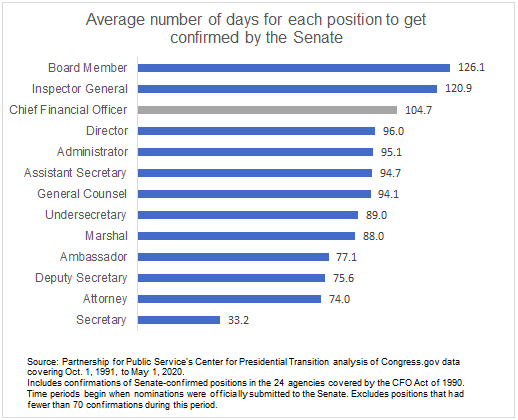
Another challenge has been the low priority given to CFOs by the Senate. One indication is the amount of time the Senate takes to confirm CFO appointees. For the nearly three-decades since the CFO law was enacted, the Senate has taken an average of 104.7 days to confirm CFOs. That is the third-longest average for any type of job within these agencies behind only inspectors general and members of various government boards.
A recent report produced by the Partnership for Public Service and Deloitte, “Finance of the Future,” made recommendations to modernize the role of CFO. One recommendation called for standardizing the position government-wide by delineating a common set of core responsibilities. This would enhance their ability to integrate and share information across agencies, transfer institutional knowledge and standardize functions.
Another recommendation called for improved continuity in CFO leadership. Currently, 15 of 24 federal CFOs are Senate-confirmed positions while the others are career positions. Congress should consider converting all CFO jobs to career positions or establishing the role as a fixed term with a performance contract. In that situation, CFOs would be expected to remain in office even with a change in administration.
Many of these recommendations are contained in a bipartisan bill proposed by Sens. Mike Enzi, R-Wyo. and Mark Warner, D-Va.
To meet the evolving needs of federal financial management, the Senate and agencies should make changes to better position CFOs to fulfill their obligations to the American people.
By Katie Malague and Dan Chenok
Building on the exponential growth of artificial intelligence over the past decade, federal agencies are using intelligent automation to further improve productivity. Intelligent automation incorporates AI, blockchain, cloud computing, robotics and other technologies, and is collectively transforming how agencies work—from managing paperwork to using data for decision-making to providing services to customers.
Indeed, past presidential administrations recognized the potential of artificial intelligence and other technologies and paved the way toward more complex use of intelligent automation: first through the National Artificial Intelligence Research and Development Strategic Plan to maximize the benefits of federal AI funding, then through the American Artificial Intelligence Initiative to accelerate AI adoption.
Whatever the outcome of the presidential election, leaders can build on these initiatives to make government operations more effective and efficient and service delivery seamless.
The Partnership for Public Service and the IBM Center for The Business of Government hosted five events this year with agencies that moved from technology pilot projects to full-scale adoption: the U.S. Marine Corps, the General Services Administration, the Department of Defense’s Joint Artificial Intelligence Center, and the departments of Homeland Security and Health and Human Services.
These events highlighted lessons for the administration to consider for its AI plans and policies, and for effective adoption of intelligent automation:
- Start with the problem, not the technology. AI and other technologies should not be spread around like peanut butter. Agencies should focus on users’ needs and process improvements to determine if technology tools would be useful to boost performance. The Marine Corps’ approach, for example, is to adopt AI tools that will help Marines solve problems and become more effective.
- Foster a culture of innovation. Supporting innovation would help reduce agencies’ risk aversion and fear of failure and encourage employees to pursue new approaches for working more efficiently. The Marine Corps fosters a culture of innovative thinking, both in business operations and war zones—leading the Marines to adopt new technologies, including AI, to become more effective. Other agencies could seek advice from the GSA, which supports innovation government-wide by, for example, helping agencies adopt new technologies and organizing the Presidential Innovation Fellows program.
- Free employee time to focus on higher-level tasks. Tools that perform repetitive tasks free employees to tackle complex tasks only people can do. DHS, for example, is using AI in its Contractor Performance Assessment Reporting System to help acquisition professionals find data about contractors and make better procurement decisions.
- Minimize bias by encouraging diversity of thought. When making decisions about AI and the data it relies on, pulling in diverse stakeholders helps minimize bias and inaccuracies. The DOD Joint Artificial Intelligence Center and its data governance council engages a diverse group of stakeholders when making data-related decisions. Stakeholders could include engineers, security experts, data scientists, ethicists and other specialists from government, industry and academia.
The event recordings are available on the Partnership’s website, and event summaries are on the IBM Center’s blog.
Katie Malague is the vice president for government effectiveness at the Partnership for Public Service.
Dan Chenok is executive director of the IBM Center for The Business of Government.
The Partnership and the IBM Center have collaborated on several other resources a second or first-term administration in 2021 might use to help government take full advantage of artificial intelligence. In our 2018 report, “The Future Has Begun,” we presented examples of the government’s successful use of AI. In the 2019 reports, “More Than Meets AI” and “More Than Meets AI Part II,” we explored impacts on the federal workforce, as well as issues of ethics, bias, security and privacy.
By Amanda Patarino and Troy Cribb
How do Americans find information about the people serving in the top decision-making positions in the federal government?
The answer is not simple. In many cases, the best option is to refer to the “Plum Book,” a government document produced every four years that is outdated by the time it is published.
The Plum Book is the most comprehensive source about officials serving in the federal government. It contains information on more than 4,000 political appointees – 1,200 of whom are subject to Senate confirmation – along with thousands of other jobs filled by senior career officials in the federal civil service.
Unfortunately, the Plum Book has been produced largely the same way since 1952, and should be modernized to provide greater transparency and accountability. Congress is currently considering legislation that would do just that, and the Partnership for Public Service supports this effort to bring the Plum Book into the 21st century.
The history of the Plum Book
The Plum Book has remained largely unchanged since President Eisenhower requested a list of the “plum” positions he could fill in his new administration. Today, the Office of Personnel Management requests information from agencies and compiles that data into one long list with a “plum” purple cover. The list is published by Congress in late November or early December of every presidential election year and provides a snapshot of the political positions and appointees who filled them that previous summer.
This means the data is only available every four years, and, as the Partnership has written, the Plum Book itself is often filled with errors. For example, the Federal Housing Finance Board was listed in the 2016 Plum Book even though it was dissolved in 2008. The 2016 Plum Book also misclassified some positions that were changed to PA (presidential appointment) from PAS (presidential appointment with Senate confirmation) by the Presidential Appointment Efficiency and Streamlining Act of 2011.
Recommendations
There are three improvements to the Plum Book that would make it more useful. First, the information should be updated more frequently than every four years to provide more timely data. Second, errors should be fixed as soon as they are caught. Third, while the Plum Book is available online as a PDF and a few other file types, it should be available in a more downloadable and machine readable format.
These improvements would bring increased transparency and accountability to the federal government by letting the American people know who is serving in the top decision-making positions. An online, up-to-date Plum Book would be an effective planning tool for the Office of Presidential Personnel or the transition team planning for a new presidency. It also would provide key information to individuals wanting to join an administration.
Current legislation
In June, the Partnership applauded the introduction of the Periodically Listing Updates to Management Act of 2020 (The PLUM Act) by Rep. Carolyn B. Maloney, D-N.Y., and Sen. Tom Carper, D-Del. As introduced, both bills would require an online database of appointees and require monthly updates, and just yesterday the bill moved through committee in the House. As the Senate bill moved through committee earlier in the summer, though, the reporting requirement was scaled back to an every-two-year update.
As the legislation moves forward in the House and Senate, the Partnership urges lawmakers to put the government on the path toward a real-time comprehensive database. This would include updating the information at least quarterly for all types of positions in the traditional Plum Book. The legislation also should create a process that will minimize errors and allow agencies to leverage systems they already use to track political appointments in order to minimize duplicative reporting.
In addition, the legislation should include guidance about reporting vacancies subject to Senate-confirmation. The Federal Vacancies Reform Act requires agencies to report information about these vacancies to the Government Accountability Office. In recent years, the reporting has been spotty and left the public in the dark as to who is assuming the duties of vacant positions subject to Senate confirmation.
Passage of the PLUM Act would bring the Plum Book and the tracking of political appointments into the modern world. Congress should seize on this opportunity to make appointee data more accurate and accessible.
Amanda Patarino is a consultant on the Center for Presidential Transition, focused on political appointments. Troy Cribb is the Director of Policy at the Partnership for Public Service.
By Thomas Kean and Lee Hamilton
Presidential transitions are a time of great vulnerability for our nation, with a significant turnover in national security personnel occurring when the nation may be facing a foreign policy crisis or an adversary willing to cause significant trouble. Many of the laws and norms that presidential transitions follow today were put in place based on lessons learned in the aftermath of the terrorist attacks of Sept. 11, 2001.
The independent, bipartisan 9/11 Commission, which we headed, examined the transition of power in 2001 from Bill Clinton to George W. Bush. We found, among other things, that the Bush administration, like others before it, did not have its full national security team on the job until at least six months after it took office.
Since a catastrophic attack can occur with little or no notice as we experienced on 9/11, we concluded that the government must seek to minimize disruption of national security policymaking during the change of administrations. In exploring this issue, our report made a series of recommendations to protect the nation from national security threats during a presidential transition.
Our proposals were adopted by Congress largely through the Intelligence Reform and Terrorism Prevention Act of 2004. The post 9/11 provisions have been integrated into the process for all transitions since and include:
- The designation of a single federal agency responsible for all security clearances. This task was originally given to the National Background Investigations Bureau at the Office of Personnel Management, and in April 2019 was moved to the Defense Counterintelligence and Security Agency.
- A requirement that the outgoing administration provide the incoming administration with a “detailed classified, compartmented summary” of national security threats, major military and covert operations, and pending decisions on possible uses of military force.
- A recommendation that the president-elect submit the names of candidates for high-level national security positions (through the level of undersecretaries of Cabinet departments) to the FBI as soon as possible after the general election, and that the responsible agencies conduct the background investigations necessary for the appropriate security clearances.
- A nonbinding sense of the Senate resolution calling on the president-elect to submit national security nominations to the Senate prior to the inauguration, and that all of those received prior to that date will receive a vote by the full Senate within 30 days of submission.
- The ability of each major party candidate to submit requests for security clearances for prospective transition team members who may need access to classified information to carry out their responsibilities. The law requires that necessary background investigations be completed by the day after the conclusion of the general election.
To be truly effective and help protect our nation from national security threats during and soon after a presidential transition, our outgoing and incoming leaders must be cooperative, take these requirements and best practices seriously, and act in the best interests of the nation.
Thomas Kean, a former Republican governor of New Jersey, and Lee Hamilton, a former Democratic congressman from Indiana, served as chairman and vice chairman, respectively, of the National Commission on Terrorist Attacks Upon the United States.
By Livi Logan-Wood and Dan Hyman
The
conclusion of the Democratic and Republican national conventions this month mark
the official start of the 2020 presidential campaign and a key turning point for
transition planning.
According to the Presidential Transition Act, within three days after the last convention ends, the federal government is required to provide presidential transition teams with specific support. By Sept. 1, 2020, the following changes will take place.
- The
General Services Administration will begin offering support services for the Joe
Biden-Kamala Harris transition team. These include a
secure IT network, hardware, software and the associated infrastructure
support.
- The Biden-Harris team
can move into federal office space. GSA
has allocated office space for up to 100 people at the Department of Commerce headquarters
for the Biden-Harris transition team. The Centers for Disease Control and
Prevention and GSA will provide COVID-19 health and safety guidelines to the
transition team, which will be responsible for implementing those procedures inside
the space as it sees fit.
- The
Biden-Harris transition team can begin the process of obtaining security
clearances. The transition team may coordinate
with the Department of Justice to submit requests for security clearances for
prospective officials who will need access to classified information after the November
election.
- A representative from the Biden-Harris transition team can attend the Agency Transition Directors Council. This council guides preparations by federal agencies for presidential transitions. The council already has held two meetings this year – one in May and one in July. Moving forward, the Biden-Harris transition team will be permitted to send a representative to ensure agency transition activities are taking place as required by law.
Because President
Trump is the incumbent, his administration is not required to create a formal
transition team. However, the conclusion of the nominating conventions presents
an opportunity for the Trump administration to plan for second term policy and
personnel changes.
The
next notable transition milestone will be on Oct. 1 when the Trump White House
and the Biden-Harris team must reach an agreement that governs how and when
transition team members can engage with federal agencies following the November
election if the Democrats are successful. This agreement also will include an
ethics plan for transition team members.
With the presidential
campaign now heading into its final months, the law dictating the beginning of official
coordination among the transition team, the current administration and federal
agencies is a testament to the importance of a smooth and peaceful transfer of
power and for effective presidential transition planning.
By Christina Condreay and Alex Tippett
The winner of this November’s presidential election will face daunting challenges—a devastating pandemic, a major economic crisis, civil unrest stemming from racial inequality and a long list of pressing domestic and national security issues. These are momentous times that accentuate the need for presidential transition planning, whether it’s a first term for Democratic candidate Joseph Biden or a second term for President Donald Trump.
The COVID-19 pandemic and its fallout will impact presidential transition planning in four key areas:
- Planning a budget and policy agenda.
- Making priority appointments to top federal jobs.
- Developing executive actions.
- Creating the White House organizational structure.
Additionally, a first-term Biden administration will have to consider a fifth area–the preparation for “landing teams” that are deployed by incoming presidential administrations to review agencies operations and policies.
The president’s budget is an important opportunity to signal the priorities of an administration, shape the congressional debate and shore up alliances.
In 2021, the president’s budget will come on the heels of congressional approval of several trillion dollars in stimulus spending in 2020 and will involve weighing trade-offs between the administration’s long-term policy agenda and the requirements dictated by the current crises. This will necessitate a high-stakes appraisal—the funding choices in this budget could shape the economic and political landscape for the next four years. Due to these challenges, work on the budget should begin early and be given greater attention and resources than in previous election cycles.
Chris Lu, the executive director of the President Barack Obama’s 2008-2009 transition, said the severe financial crisis occurring when Obama took office pushed many policy concerns “to the backburner.” Transition planners should develop the budget to highlight major policy goals for the year ahead even if the immediate crisis remains the top priority.
Presidents are responsible for appointing about 4,000 officials throughout the federal government. A new president must fill these positions from scratch while second-term presidents often face significant staff turnover. According to previous research by the Partnership for Public Service, the first year of a second term coincides with an average turnover rate of more than 40% for senior leadership positions. Both before and after the Nov. 3 election, it is critical for transition planners to focus on public health and economic policy appointees who will be responsible for overseeing the response to the COVID-19 pandemic and the sagging economy.
The specific priority positions will depend on how a new administration structures its response, while a second-term administration may take the opportunity to reshape its efforts. A Cabinet-led response will require the administration to prioritize agency leadership positions while a response driven by the White House will call for a different staffing structure. Transition planners should develop a clear picture of what the post-election COVID-19 response will look like and identify key personnel for this effort.
The pandemic also has created several second-order threats such as increased cybersecurity risks with a remote workforce as well as greater global instability. The next administration should recognize that successfully navigating the current crises will require filling positions without traditional “pandemic-response” roles in agencies throughout the government.
The pandemic also will create operational challenges for presidential appointees. Procedures will have to be developed for previously routine issues, ranging from how to conduct safe and secure briefings with new appointees to the best way to work with a potentially remote Senate. The challenger’s transition team will need to closely coordinate with the General Service Administration (GSA), which provides the transition with office space, IT equipment and other support.
According to Mary Gibert, the federal transition coordinator at GSA, the groundwork for a virtual transition, however, has already been laid. In the last transition, much of the work was already conducted virtually, with many of personnel choosing to work on GSA-provided devices rather than come into the office. “COVID has not impacted our transition planning,” Gibert says. “We haven’t missed a beat. We’ve kept up with all our statutory requirements.”
Those involved in overseeing a second Trump term will have to ensure the Office of Presidential Personnel can ramp up its efforts to meet an expected turnover of political appointees on top of a high level of current vacancies, and determine where it can improve operations and procedures to better deal with the challenges resulting from the pandemic.
Prioritizing key executive actions will advance policy goals
Executive
actions are one tool presidents can use to enact significant change–and do so
quickly. Effectively using executive orders for achieving policy goals may
be more challenging in 2021 because so much attention must be devoted to
dealing with the immediate crises. Transition planners for both first- and
fifth-year administrations should take time to develop executive orders and
anticipate potential operational and legal challenges well before Jan. 20.
First-year administrations face a two-pronged challenge. They must advance the new president’s agenda while evaluating previous executive actions and rules they want to change. This can be a huge undertaking even under normal conditions. Resource constraints created by the pandemic will make it difficult for a new administration to accomplish all its goals. An incoming administration should concentrate on the most critical subset of issues. Doing so will prevent it from spreading itself too thin and increase its chances of success. Historically, there has been a decline in the number of executive orders issued by a president during the fifth year in office compared with the first term. In interviews with the Partnership for Public Service, former senior White House officials suggested the focus on re-election often limits formal planning for a president’s fifth year. If an administration is facing both a crisis and a re-election campaign, as is the case today, developing fifth-year executive orders may well fall to the bottom of the agenda. Investing time and resources in planning an executive agenda now, however, may allow the president to start the fifth year more effectively and set a productive tone for the rest of their presidency.
The White House structure must be equipped to respond to the current and future crises
All presidents seek a White House
organizational structure that will lead to a smooth functioning operation and enable
them to achieve their key policy priorities. New administrations must create this
structure from scratch while a second-term administration has the opportunity
to reexamine its White House design and improve areas of weakness. Any such
redesign, however, will need to be attuned to the demands of the current crisis.
Different presidents have relied on a variety of organizational structures to address crises. During Harry Truman’s presidency, Congress created the National Security Council in 1947 to help the president coordinate national security policy. In 1993, President Bill Clinton created the National Economic Council by executive order to help coordinate the economic policy-making process and provide economic policy advice.
These entities centralized decision-making and the flow of information. Other presidents have relied on temporary arrangements such as President Obama’s appointment of an Ebola czar in 2014 to coordinate what was then the world’s biggest health threat. This type of temporary structure can be valuable but cannot provide the same institutional knowledge offered by a more permanent organization. Both first- and fifth-year administrations should use the transition period as an opportunity to evaluate the current pandemic response structure and determine if changes are needed. The next administration also should assess how to operate in a partial virtual work environment. A new administration should seek expert guidance and develop contingency plans while the current administration should identify problem areas that need to be resolved. Identifying and resolving these issues long before Inauguration Day will ensure a smooth start for a new administration or lead to improved conditions for a second term. Lessons could be learned from the agencies across government who are currently operating partially or totally virtually. Despite working virtually, agencies like the IRS and FEMA have managed to fulfill their normal mission requirements in addition to the new demands created by COVID-19. A new administration will have to demonstrate a similar level of agility.
A new administration must understand how agencies operate
A
new administration must have a thorough understanding of every federal agency’s
capabilities and responsibilities. To do this, presidential transition teams traditionally
create landing teams that enter agencies following the election and gather relevant
information. The roles of various agencies can change rapidly during a crisis. The
transition landing teams must flag challenges related to the pandemic so that
those issues can be evaluated and resolved.
Landing teams should also map the statutory landscape for each agency. Do agencies have emergency powers they are not taking advantage of? Are agencies exceeding the legal limits of their authority? An incoming administration must be aware of all these issues to mount an effective COVID-19 response. In addition, federal agencies must coordinate with one another, the private sector, state and municipal governments, and international partners during a crisis such as a pandemic. Landing teams should document these relationships so an incoming administration can take immediate control and identify potential pain points that need to be resolved.
Conclusion
Whether it’s a second Trump term or a first term for Biden, our
government must be prepared to tackle the pandemic and the nation’s economic problems
in addition to the challenges associated with any presidential transition. This
will require thorough transition planning that accounts for the uniqueness of
the current crises.
By Paul Hitlin
August 18, 2020, will mark the 100th anniversary
of the ratification of the 19th Amendment to the Constitution granting
women the right to vote. While this conferred a decisive role for women at the
ballot box, it has not yet opened all doors for them to participate in every
element of the federal government.
Women have filled many essential jobs, yet there are still important leadership positions that have never been held by a woman. For example, not only has no president or vice president been female, but three Cabinet agencies have never had a woman secretary: the departments of the Treasury, Defense and Veterans Affairs.
The following are 12 important positions in the federal
government that have never been filled by a woman.
- President – None of the 44 individuals who served as president have been women. Hillary Clinton was the first woman to be nominated by a major political party in 2016.
- Vice president – Only two vice presidential nominees of major political parties have been women: Geraldine Ferraro in 1984 and Sarah Palin in 2008. Presidential candidate Joe Biden has announced he will select a woman to be his running mate in 2020.
- Chairman of the Joint Chiefs of Staff – Twenty men and no women have filled the most senior position in the U.S. armed forces since its creation in 1949.
- Chief Justice of Supreme Court – Only four justices in the 230-year history of the Supreme Court have been women, and none have been appointed chief justice.
- Chief of Staff to the President – Since President Harry Truman appointed the first chief of staff in 1946 – called the assistant to the president at the time – none of the 29 people to hold this position have been women.
- Director of the Federal Bureau of Investigation – The first leader of the FBI was appointed in 1908, and none of the 20 directors (including those in an acting capacity) have been women.
- Director of National Intelligence – All six people to hold the Cabinet-level position since it was created in 2004 have been men.
- Director of the National Security Agency – Women have never held the highest-ranking position in the NSA since the intelligence agency was founded in 1952.
- Secretary of Defense – The Department of Defense has never been led by a woman since its inception in 1947. No woman has been confirmed to be deputy secretary of defense either, although Christine Fox was named acting deputy secretary in 2013.
- Secretary of the Treasury – Alexander Hamilton was the first in this position in 1789, and none of the 76 secretaries who followed have been women.
- Secretary of Veterans Affairs – The Department of Veterans Affairs was formed in 1989, and all 10 of the Senate-confirmed officials who led the agency have been men.
- Senate Majority Leader – No Senate majority leader has been female since that role was created in 1925. In fact, no Senate minority leader has been a woman during that period either.
This list is not exhaustive. Other important positions such
as the NASA administrator and secretary of the Army also have not been held by a
woman. Some positions have only had a woman official recently. For example,
Gina Haspel became the first female director of the CIA when she was confirmed
in 2018.
As the country prepares to mark the centennial of the 19th
Amendment, women who have served as leaders of our democracy deserve
recognition and appreciation. At the same time, their absence from key
positions in government, and thus from critical conversations in domestic and
foreign policy, is worth highlighting.
Extensive research indicates diverse and inclusive teams produce better outcomes, and that well-qualified women are ready to lead. While the last 100 years has witnessed some progress, more work needs to be done to ensure the top levels of our government resembles the country it serves. To learn more about the role women have played in national security, listen to our Transition Lab podcast.
By Paul Hitlin
Temporary leaders – commonly referred to as acting officials – have been used by all recent administrations to fill important positions atop federal agencies. Many questions surround their use and power. How long can acting officials serve? Who is eligible? What happens when the time limit for an acting official runs out? Most of the rules are governed by the Federal Vacancies Reform Act of 1998. However, the law gives presidents a fair amount of flexibility and many details are open to interpretation.
Little research exists on the subject,
but a new scholarly article examines the issue in depth and provides important
considerations and recommendations. The piece by Anne Joseph O’Connell of Stanford
Law School published in the Columbia Law
Review includes data from 1981 through President Trump’s third year in
office, and discusses many impacts of temporary leadership.
Among the major findings:
- President Trump has utilized significantly more
acting Cabinet secretaries than prior presidents.
- Previous presidents relied on temporary leaders,
particularly at the start and end of administrations.
- Without Senate confirmation, temporary officials
may lack external buy-in from Congress and the White House.
- Not all impacts of temporary officials are
negative. For example, temporary leaders seeking the permanent job may provide
the Senate with an audition.
O’Connell offers recommendations for clarifying the Vacancies Reform Act.
- Congress should remove ambiguities in the
Vacancies Reform Act to “discourage end runs around the normal appointments
process.”
- The law should include agency-specific
succession provisions.
- The law should address presidential firings.
- The law should specify that for officials to
qualify as a first assistant – and thus be eligible to serve as an acting role
– they must be named before the vacancy arises.
- The law should address whether the mandates
about qualifications and removal for confirmed officials apply to temporary
officials.
O’Connell points out that acting officials have become a fixture of modern presidencies despite receiving little attention, and that Congress has abdicated some of its advise and consent role by accepting increased reliance on interim leadership. To balance concerns over accountability and the need for the government to function, O’Connell argues that it is time for Congress to clarify the rules governing the use of acting officials.
By Jaqlyn Alderete
The Senate now takes 115 days on average to confirm presidential appointees, twice as long as during the Reagan administration.[1] Given the length of time it can take to get nominees confirmed, a new administration or second-term administration must prepare to face the reality of having vacant positions and identify their options for filling those roles.
In the beginning of a new administration, it is common for most presidentially appointed Senate-confirmed positions to be filled by acting officials while the nomination and confirmation process plays out. Second-term administrations typically experience significant turnover in critical leadership roles following re-election. According to the Center for Presidential Transition’s report on turnover during the previous three administrations, 43% of key leadership positions were left vacant within six months of the start of a president’s second term, either by personal choice or because the president wanted a change and fresh ideas. Given the high turnover rate, second-term administrations must plan for how they will fill these roles while waiting for the Senate confirmation process to play out.
The Federal Vacancies Reform Act outlines limitations to who can serve in acting roles and for how long. Under the Vacancies Act, there are three types of officials who may carry out the duties of the vacant position in an acting capacity without Senate confirmation.
- The “first assistant,” interpreted to be the top deputy position, becomes the acting officer unless the president designates another individual from the other two eligible classes of officials. The Vacancies Act does not specifically define “first assistant.”
- The president may designate an individual who serves in another presidentially appointed, Senate-confirmed position elsewhere in the federal government as the acting official.
- The president may designate a senior employee of the same agency as the acting official if that person has served in the agency for at least 90 days during the year preceding the vacancy and is paid at a rate equivalent to at least a GS-15.
The Vacancies Act limits an individual serving in an acting role for 210 days. However, this period is lengthened to 300 days if a vacancy exists on the new president’s inauguration day or occurs within 60 days after the inauguration.
While these all are helpful ways to manage vacancies, they are temporary placeholders for long-standing leadership positions, as acting officials lack the authority that comes with a presidential appointment and Senate confirmation process. It is imperative that administrations develop efficient procedures for sending nominees to the Hill and that they prepare to manage vacancies within the limits of the Vacancies Act.
[1]
Center for Presidential Transition, “Senate Confirmations Process Slows to a
Crawl,” Jan. 2020. Available at https://presidentialtransition.org/publications/senate-confirmation-process-slows-to-a-crawl/
As we mark the centennial of the 19th Amendment
that gave women the right to vote, it is clear women have made progress at all
levels of government. Officials such as former Secretary of State Condoleezza
Rice during George W. Bush’s administration, senior advisor Valerie Jarrett during
Barack Obama’s administration, and Gina Haspel, CIA director since 2018, have
shaped history through their public service.
The past 100 years have also marked a shift in the federal
government, with each presidential administration relying more on its advisors,
or “A-Team.” Brookings Nonresident Senior Fellow of Governance Studies Kathryn
Dunn Tenpas, in her new study, “The
President’s Advisors: An Analysis of Women on the President’s ‘A-Team’” found
that women have made up less than one fourth of this influential group during
the past 36 years.
Tenpas quotes presidential scholar Bradley Patterson, who
explains the importance of the presidents’ advice-givers. “Staff members have
zero legal authority in their own right, yet 100 percent of presidential
authority passes through their hands.”
These advisors serve as content filters for the president, informing every decision they make. The team is critically important, but even today, these advisors are overwhelmingly male.
Tenpas analyzes the National Journal’s list of “Decision
Makers,” which outlines the most influential members of a president’s team, to create
her A-team of the advisory positions that have consistently played a key role
in the past five administrations—from Ronald Reagan to Donald Trump. Here’s
what she learned about the A-teams that served from 1981 to 2017:
- Only 22% of 368 “Decision Makers” were women.
- Women served more in policy advisor roles than administrative,
communications, legal counsel, outreach or management.
- Women were less likely to have public-sector
backgrounds before reaching the top advisory level. Tenpas suggests women need
more access to stepping stone jobs inside government that are more likely to
pave the way for securing senior White House positions.
- Women are more likely to get hired after working
on a campaign, suggesting that campaigns provide a stepping stone into an
administration.
- Little pay disparity exists between men and
women, likely due in part to pay scales set for each position.
While women have earned more seats at the table – in 1981, only
5% of Reagan’s A-team members were women versus 34% in 2009 during the Obama administration—Tenpas’
research shows there’s still much progress to be made towards equality.
Though slow progress is better than no progress, women
remain dramatically underrepresented in presidential advisory roles. As the
presidential candidates consider who will influence their administration
beginning in 2021, it’s important that their advisors adequately reflect the
country they serve.